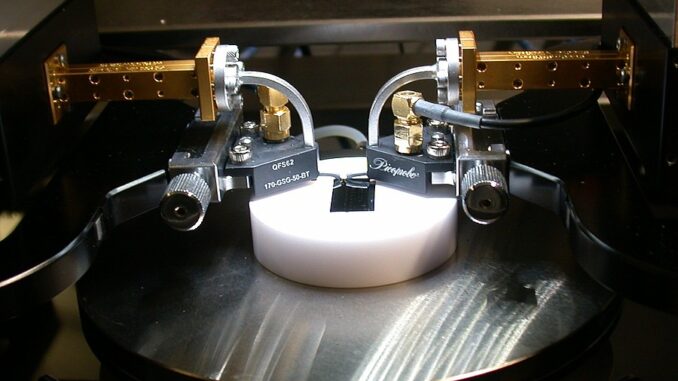
PTB News 3.2025 – To date, it has not been possible to compare on-wafer measurements because the measuring equipment and laboratory conditions significantly differ from each other and there have not been any reference substrates. The first international measurement comparison has now taken place. PTB has confirmed its high-frequency calibration capabilities on reference substrates and has developed the world’s first complete measurement uncertainty budget of up to 330 GHz.
Precise on-wafer scattering parameter measurements are an indispensable tool for developing and characterizing semiconductor wafers for new high-frequency technologies, which are used in next-generation wireless communication systems (6G), radar sensors (e.g., 77/120-GHz automotive radar), the Internet of Things (IoT) and automated driving.
National metrology institutes such as PTB and NPL (UK), renowned research institutes and universities as well as leading measuring instrument manufacturers were involved in this first comparison measurement. At the University of Lille, a set of identical reference substrates made of highly resistive silicon wafers was manufactured specifically for the comparison, and the participants each received a specimen. Apart from various calibration standards, the reference substrates contained different measuring standards and verification standards, e.g., attenuators, offset shorts and mismatched transmission lines. The coverage of the ext reme ly wide measurement frequency range from 10 GHz to 1.1 THz was reached by using a total of six waveguide frequency band extensions of the respective vector network analyzer, which differ in terms of the manufacturer, the measurement tips and their pitch size. Despite these differences, the measurement comparison showed a generally good agreement of results from the participants. The measurement results in the upper waveguide frequency band up to 1 THz were within a tolerance band of ±2.5 dB, both for an attenuator and for a mismatched transmission line.
The measurement uncertainty budget established by PTB as part of the comparison takes into account instrument influences such as noise, non-linearity and drift of the applied vector network analyzer, influences of cable movements, contact repeatability as well as the uncertainty contribution caused by crosstalk between measurement ports.
PTB’s expertise in the field of on-wafer scattering parameter metrology is the result of continuous research carried out for example by participating in various EU research projects with the objective of metrological traceability of on-wafer measurements. PTB’s work has now led to the world’s first and, to date, only database entry of the measurement capabilities (CMCs) in the BIPM key comparison database up to 118 GHz and to the issuance of the world’s first calibration certificate for commercial calibration substrates. In the years to come, PTB will enhance its on-wafer measurement capabilities by procuring a broadband measurement setup up to at least 220 GHz with temperature variation from –40 °C to 200 °C.
Contact
Gia Ngoc Phung
Department 2.2
High Frequency and Electromagnetic Fields
Phone: +49 531 592-2226
gia.phung(at)ptb.de
Scientific publication
F. Mubarak et al.: An interlaboratory comparison of on-wafer S-parameter measurements up to 1.1 THz. IEEE Trans. Terahertz Sci. Technol. (2025), DOI: 10.1109/TTHZ.2025.3537461
European metrology research
More information on the Onmicro project: https://www.ptb.de/epm2023/onmicro/home