
by Dan Wiswell
When considering this article, I thought I’d give you all a short summer read and present a few instruments that I don’t focus on very much. Thinking back on subjects I’ve previously written about, I figured that it was time to look at the Westinghouse meters in my collection as I’ve already shown meters and instruments made by one of that company’s competitors, Thomas Edison and the General Electric Company. Now that I have, I’ve found that it is difficult to focus on Westinghouse history very much because George Westinghouse was a very busy guy. It would be easy to go off on many tangents when writing about this man as he had his hand in so many ventures starting from a very early age. As an overview, George Westinghouse was granted his first patent when he was nineteen years old. During his life he held more than three hundred and fifty patents and founded over sixty companies. By 1900 more than fifty thousand employees were on his various payrolls. He had his hand in so many ventures that they seem to have no boundaries. He was involved in a dizzying array of industries that include not just electrical construction, transmission, and distribution, but also transportation, communications, entertainment, broadcast news, nuclear power, aerospace, consumer products–it’s hard to know where to stop.
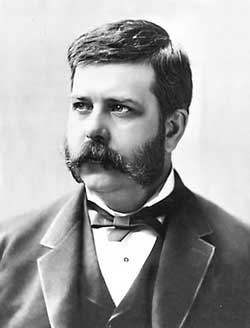
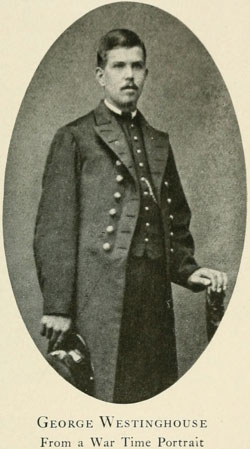
George Westinghouse was born in 1846 in Central Bridge, New York. He was named after his father, George Sr., and as a boy he worked in his father’s Westinghouse Company where they manufactured farm automation equipment among other things.
At the age of fourteen he attempted to join a local regiment to fight in the Civil War but was stopped by his father. At seventeen his parents relented, and he joined the 12th regiment of the New York National Guard after which he transferred to the 16th regiment of the New York Cavalry.
He was honorably discharged in November of 1863 and almost immediately joined the Union Navy. After the war he returned home and honed his engineering skills in his father’s machine shop. This seems to be the point at which this young man’s career went into high gear. By the end of the 1860’s he had already patented several devices related to steam engines and railroad braking and switching equipment, and in 1869 he founded the Westinghouse Air Brake Company (WABCO). He was twenty-three years old.
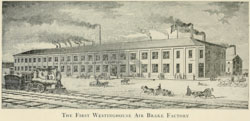
During the 1870s he employed thousands of workers at WABCO. His engineering staff improved his brake and switching systems, which transformed railroad safety in an era when thousands of rail workers were killed or maimed each year. In 1881 George Westinghouse founded the Union Switch and Signal Company. This company’s products are still being used in modern rail systems. Many of these devices have passed through my own laboratories when they required repair or calibration.
In the late 1870s natural gas exploration began in Pennsylvania and George Westinghouse immediately saw the commercial potential of this natural resource. He began drilling for natural gas on his estate in Pittsburgh, and by 1886 his Philadelphia Company owned nearly sixty wells and approximately one hundred and fifty miles of distribution pipelines in the metropolitan Pittsburgh area.
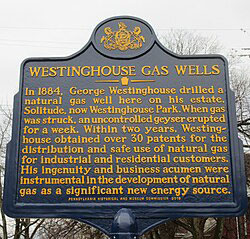
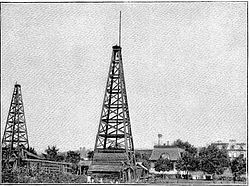
By the following year his company was supplying natural gas to over twelve thousand homes and nearly six hundred industrial customers throughout Pennsylvania. Not satisfied with exploiting natural gas, by the early 1880s he began directing his energies toward the newly established field of electrical power. He began competing with Thomas Edison in 1884 and created his own distributed direct-current-based system with the help of physicist William Stanley Jr.
In the fall of 1885, Mr. Stanley began construction on a prototype electrical distribution system based on transformers and alternating current. The system was powered by a Westinghouse steam engine and a Siemens 500 VAC electrical generator. Located in the western Massachusetts town of Great Barrington, it was originally designed to electrically illuminate approximately two dozen businesses along the town’s main street. It distributed power by stringing cables from tree to tree and used Stanley’s transformers to transmit and then step the voltage down from the 500-volt primary output of the generator to the 100 volts at which the incandescent light bulbs operated, at minimal loss. The system is now recognized as the world’s first transformer and AC powered electrical-distribution system. It became the prototype for future AC power systems that Westinghouse began installing around the United States beginning the following year in 1886. Many dozens of these systems were created in the next few years.
This timeline is important to consider for several reasons. In 1886, The Boston Edison Company was originally incorporated as the Edison Electric Illuminating Company of Boston. Back then Edison Electric Companies were only supplying direct current to their customers. Westinghouse and Edison would not have mixed very well if they happened to show up at the same party, as Edison didn’t particularly care for competition of any kind. The rift between these gentlemen escalated as events moved forward. In the beginning, when transmission and distribution of electric power was all done on a local level, the pros and cons of each approach could easily be debated. However, as electrical power systems grew to encompass larger geographic areas, the advantages of AC power transmission became obvious. In 1892, it was J.P. Morgan that forced Edison’s hand by demanding that Edison’s General Electric Company switch over to AC power. Next, as one of the company’s primary shareholders he forced Edison out of his own company. As you may imagine, quite a bit of bad blood and strategic maneuvering ensued, the likes of which are beyond the scope of this article—all of which can easily be found in many sources both in print and online. Which (finally) brings us around to my original intent of showing some electrical instruments.
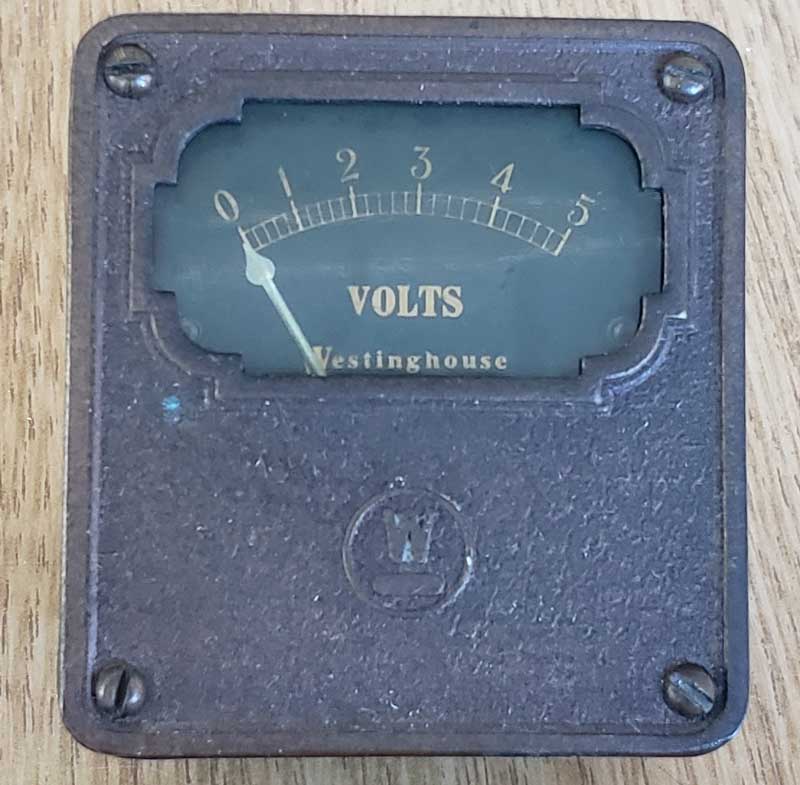
Many years ago, I was sifting through a pile of scrapped electrical equipment and happened upon a discarded front panel from an old dry-cell battery charger. Most of the components mounted on the chassis were missing, but it still had a working panel meter. That meter became one of the first instruments to make its way into my collection. It was made in 1898 and is depicted to the left.
I guess I thought it would make a good paperweight, as it only measures about two and a half inches square. I never imagined that I would be writing about it someday. Most of the other Westinghouse pieces in my collection are switchboard panel meters. This probably makes sense as these meters are mostly taken from old electrical service panels from Westinghouse switch gear. My collection from this brand name would probably outweigh everything else I’ve got if I had focused on glass-jar-style watt hour meters, much to the relief of my wife. We’d probably be passing salt and pepper shakers around them at the dinner table. A few examples of these meters are depicted in the next few pictures below. These meters were used to monitor AC current, power factor, and frequency.
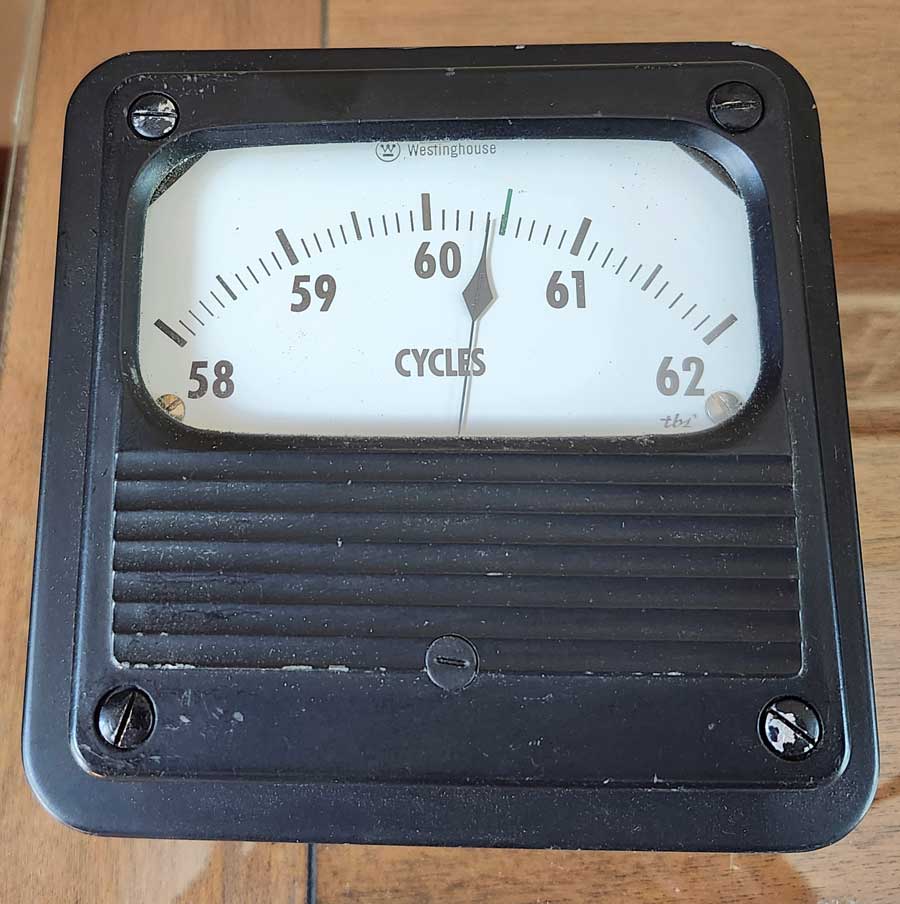
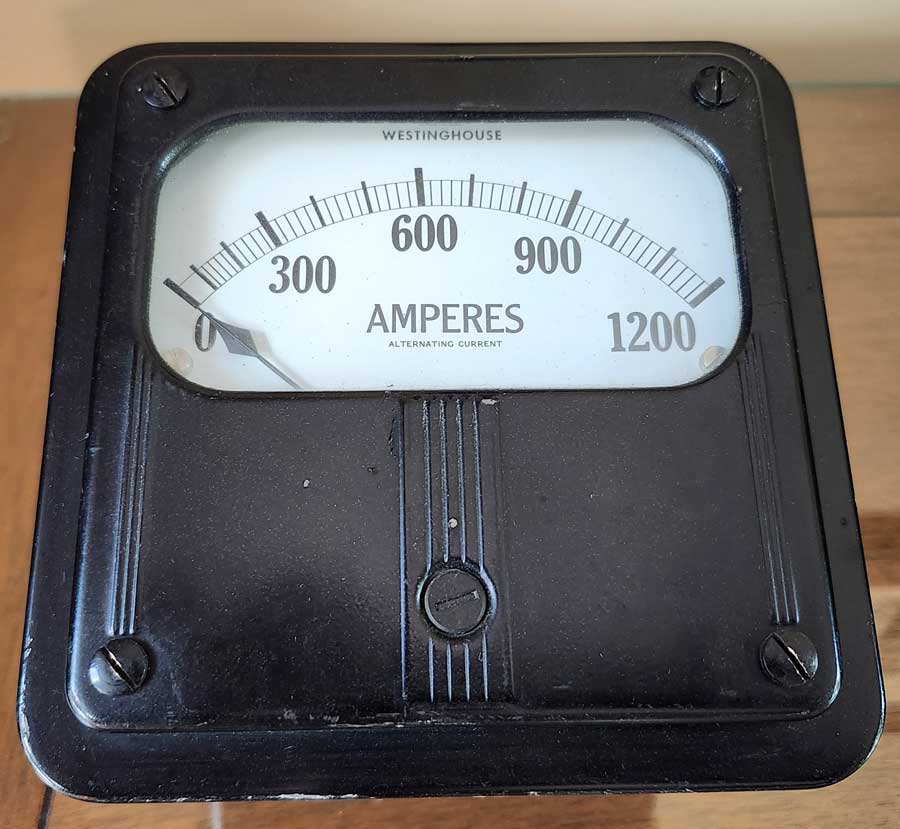
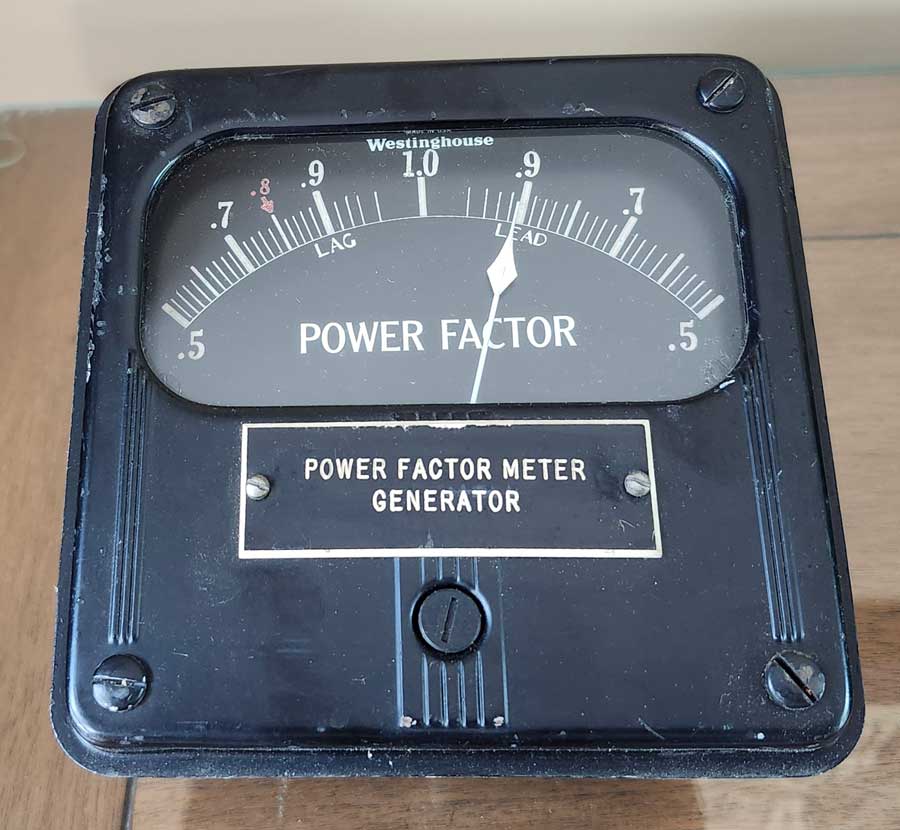
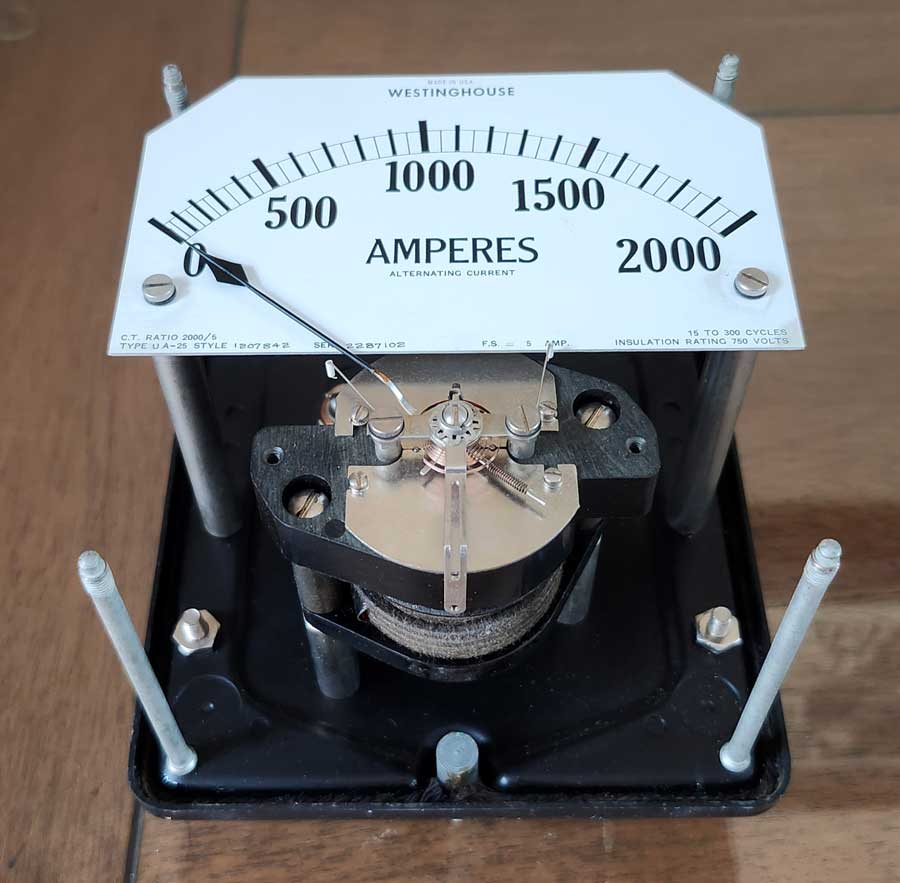
These meters were designed with AC iron-vane meter movements. Iron-vane meter movements were most often designed with five-amp field coils, which is why most current transformers have N:5 ratios. This type of movement can be seen in detail below.
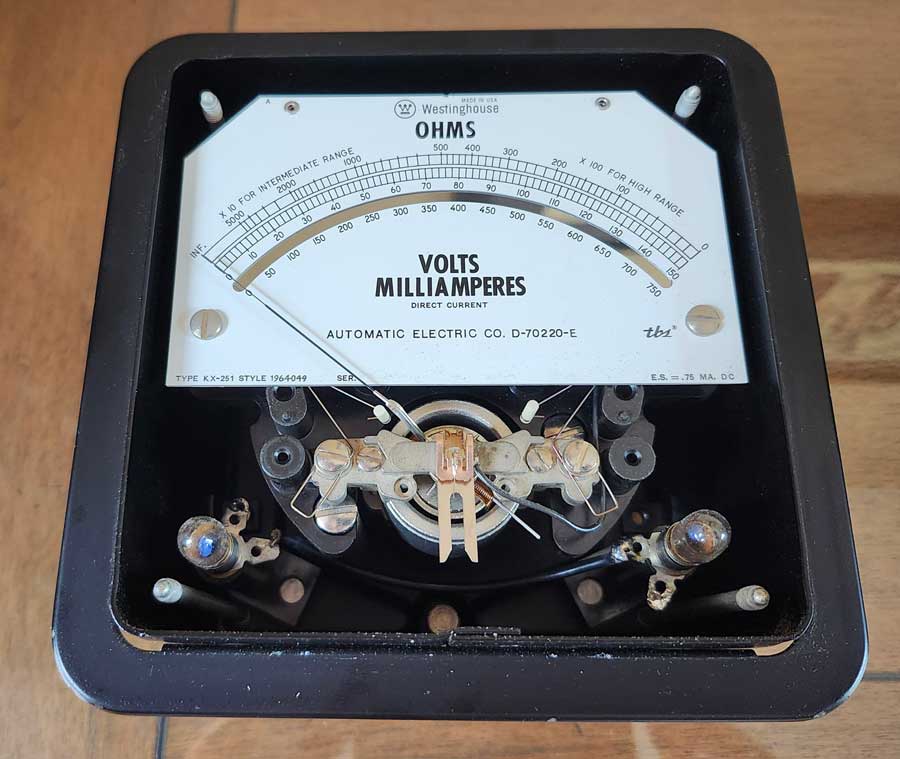
One of the Westinghouse panel meters that I salvaged came from a meter calibrator made by the Automatic Electric Company, a large manufacturer of telephones and telephone switching equipment. Although it looks like the other panel meters in this series, the picture detail shows that instead of an AC iron-vane meter movement, it has a DC, taut-band style meter movement (below picture). This is signified by the letters TBS on the meter scale which stands for “taut-band suspension.”
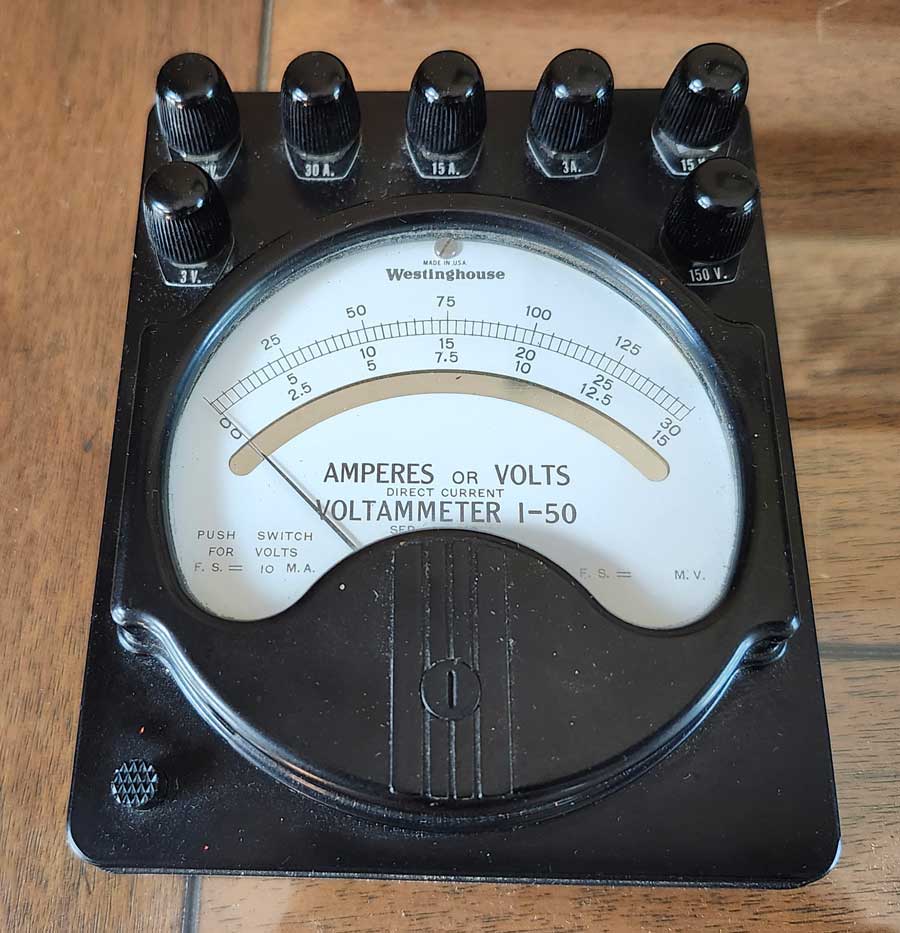
I’ll close by showing an absolutely beautiful piece of test equipment. It is the only Westinghouse test instrument I’ve got. I found it tucked away in one of the drawers of a work bench from one of my mentors who passed away many years ago.
Pete Peterson, this one’s for you. Thank you for starting me on this path. I’ve carried your love of metrology forward as best as I’ve been able. My life has been enriched many times by the lessons I’ve learned from you.
References
- Wikipedia contributors. (2025, August 13). George Westinghouse. In Wikipedia, The Free Encyclopedia. Retrieved 17:45, August 27, 2025, from https://en.wikipedia.org/w/index.php?title=George_Westinghouse&oldid=1305619458
- “George Westinghouse Timeline.” Library of Congress. Retrieved 17 September 2024. https://www.loc.gov/collections/films-of-westinghouse-works-1904/articles-and-essays/timeline/
- “William Stanley – Engineering Hall of Fame”. Edison Tech Center. 2015. Retrieved 7 October 2017. https://www.edisontechcenter.org/WilliamStanley.html
- The Westinghouse Legacy, https://www.thewestinghouselegacy.org/
Dan Wiswell, North Billerica, Massachusetts