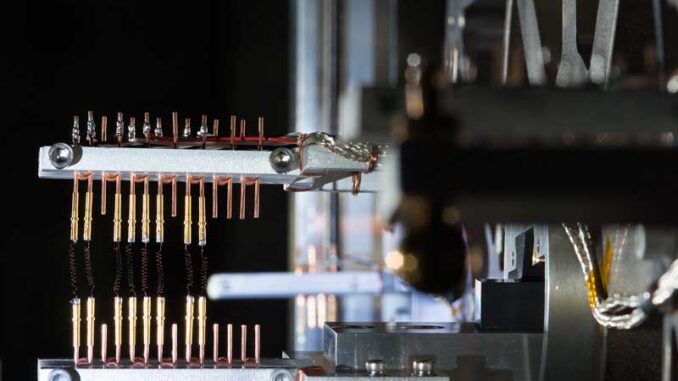
The NIST-4 Kibble balance is an electromechanical machine that measures the mass of objects roughly 1 kg. Here, you can see the top of the balance, which includes a wheel that rotates back and forth as the two sides of the balance move. Just visible on the left side of the image are a set of thin electrical wires that connect the electromagnetic coil (not pictured) to other key parts of the balance. Incidentally, the reason the thin wires are coiled like springs instead of being pulled straight is so that as the wheel moves back and forth, the wires stretch without touching each other. Credit: Jennifer Lauren Lee/NIST
In a brightly lit subterranean lab at the National Institute of Standards and Technology (NIST) sits a room-sized electromechanical machine called the NIST-4 Kibble balance.The instrument can already measure the mass of objects of roughly 1 kilogram, about as heavy as a quart of milk, as accurately as any device in the world. But now, NIST researchers have further improved their Kibble balance’s performance by adding to it a custom-built device that provides an exact definition of electrical resistance.
by Sita Schwartz, Editor The Colorado Engineering Experiment Station, Inc. (CEESI), a subsidiary of Western Energy Support & Technology, Inc. (WEST), provides accredited NIST traceable calibration for numerous types of flow meters for customers around […]
February 13, 2011, Washington, D.C. – Announced today, President Barack Obama’s fiscal year (FY) 2012 budget submitted to Congress for the U.S. Commerce Department’s National Institute of Standards and Technology (NIST) proposes a funding level […]
by Martti Heinonen Europe aims at climate neutrality by 2050; to achieve this, plastic recycling needs to be increased through better processes and technologies. There is an increasing need for measurement technology that enable efficient […]