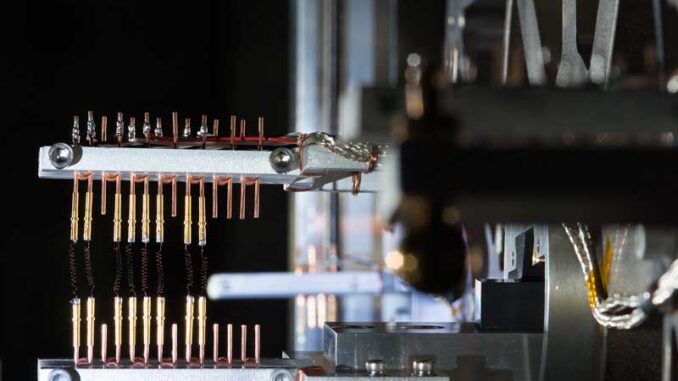
The NIST-4 Kibble balance is an electromechanical machine that measures the mass of objects roughly 1 kg. Here, you can see the top of the balance, which includes a wheel that rotates back and forth as the two sides of the balance move. Just visible on the left side of the image are a set of thin electrical wires that connect the electromagnetic coil (not pictured) to other key parts of the balance. Incidentally, the reason the thin wires are coiled like springs instead of being pulled straight is so that as the wheel moves back and forth, the wires stretch without touching each other. Credit: Jennifer Lauren Lee/NIST
In a brightly lit subterranean lab at the National Institute of Standards and Technology (NIST) sits a room-sized electromechanical machine called the NIST-4 Kibble balance.The instrument can already measure the mass of objects of roughly 1 kilogram, about as heavy as a quart of milk, as accurately as any device in the world. But now, NIST researchers have further improved their Kibble balance’s performance by adding to it a custom-built device that provides an exact definition of electrical resistance.
By Heather A. Wade A customer may send equipment to a calibration vendor for calibration with the expectation of quickly receiving it calibrated. The only instructions sent with the equipment may be “please calibrate this.” […]
by David M. Walker This article discusses some of the issues for US manufacturers of metrology equipment when dealing with European Union funded programs. It is often the case that ‘EU’ funding is available only […]
PTBnews 2.2023 A method for calculating the simulation uncertainty of a virtual ultrasonic flowmeter has been developed in PTB’s VirtMet Competence Center. This method allows calibration factors relevant to fluid mechanics to be calculated for […]